Preparation - agreeing on aims
Most Division/school partnerships noted that one of the most difficult parts of the process was
deciding what to do
. It took a considerable amount of time to determine and agree on aims for the partnership. Most of the discussion was around what were the students' and school communities' needs and what might be achievable through the Division/school partnership
The first step is generally looking at the student/school needs regarding mental health support. This requires knowing what the main mental health support needs were for the local student population. These needs vary according to the student population group, as schools serve diverse local communities. For example, for some schools, the needs of students from culturally and linguistically diverse backgrounds are paramount, while for others the needs might relate to particular risk factors for students such as student pregnancy. Only the local school community can determine what their particular needs are.
Useful resources to determine student mental health needs include an understanding of the main mental health issues for young people. More information about young people's mental health is provided at
Resource 6: Young people's mental health problems
.
Home
A
|
needs analysisAbout AGPN is one of the most important areas to focus on to get the partnership started. The main steps in a needs analysis are:
|
Consumers & Divisions
|
- undertake a "gap" analysis to identify the mental health needs of high support. List those needs that are currently met, partly met and unmet.
Annual Forum
- prioritise the identified unmet needs.
|
- list possible causes of these unmet needs.
Discussion Forums
- list the consequences of continuing to not meet these needs and the benefits of meeting them.
|
- identify possible opportunities and solutions.Divisions Directory
|
Clearly, many needs around mental health support will be identified and the Division/school partnership will not be able to address all of these. The partnership must determine what it will choose to focus on.Document Library
It may be helpful to recall, as shown on
page 25Executive Leadership and Management Program, that the projects that have developed so far under Phase 1 of the
|
MindMattersPrograms
|
Plus MediaGP initiative have been grouped into three broad areas of activity:
|
Events
|
- developing clinical referral pathways (e.g., from the classroom teacher, to the school counsellor, to the GP)
Contact AGPN
- expanding networks of care (to incorporate the GP and other community health and support services)
|
- enhancing student confidence, skill and knowledge in seeking help and managing their health.Links
|
Another helpful activity to use in order to help determine needs and to identify areas that the Division/school may want focus is to undertake a SWOT analysis. This means brainstorming the My AGPNStrengths/Weaknesses/Opportunities/Threats
that might exist for your particular Division/school partnership.
Search
Some more information about a SWOT analysis within the education setting is available at:
|
http://www.teachernet.gov.uk/professionaldevelopment/tipd/guidance/swot/Site Map
|
Note that it is absolutely essential that all members of the school community are Helpinformed of progress
|
regarding the project. This includes the school executive, school staff including administrative staff, parents and students. Some partnerships have found it useful to have a short newsletter or ensure that there is space within the school newsletter to keep the school community informed.Hot Issues
When the school community is not informed, people can become concerned and worried about the initiative and the consequence is that the aims of the partnership are not supported and are not able to be achieved and sustained. When the school community is kept informed, and where possible involved, these problems do not arise and support for the initiative is forthcoming from all parties.
Figure 5 shows some of the processes involved in determining the aims of the Division/school partnership. Essential points to note about this preparation are the © Copyright 2007 documentation Pregnancy Lifescriptsand
support
processes. As noted earlier, support from within the school is essential. Also fundamental to the success of the partnership is appropriate documentation of decisions and decision processes.
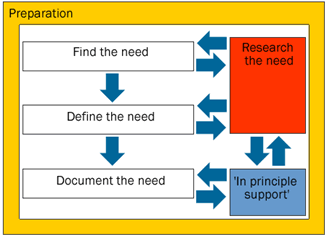
Figure 5. Determining the aims of the Division/school partnership
Source: Wilson et al (2004)
A detailed description of the processes involved in developing a Division/school partnership is provided in Wilson et al and is also available the Divisional Resource Centre at: http://ndya.adgp.com.au/