|
What's new?
Chronic Illness: Australia's Health Challenge
The Australian Chronic Disease Prevention Alliance (ACDPA), a group of leading non-government organisations addressing the chronic diseases of heart, stroke and vascular disease, diabetes, kidney disease and cancer, have worked collaboratively with key economists around Australia to document the economic case for prevention, with a particular focus on nutrition and physical activity. The National Health Priority Action Council (NHPAC) and the National Public Health Partnership (NPHP) have also supported the ACDPA in this important work, which highlights the need for continuing action and investment in the prevention of chronic disease by addressing the risk factors of nutrition and physical activity.
The ACDPA has now published a small series: Chronic Illness - Australia's Health Challenge, which describes the challenge in both health and economic terms and flags the need to measure the economic impact of chronic illness. These documents will soon be available on the websites of each of the ACDPA member organisations which are:
To download the ACDPA series Chronic Illness: Australia's Health Challenge now please click on the link below. http://www.heartfoundation.com.au/acdpa
APNA VICTORIAN WORKSHOP - 27 & 28 August 2004 Our inaugural State workshop was attended by over 100 practice nurses and Division staff. Acrobat files of the presentations can be downloaded by clicking on the links below:
DAY 1
How Australian GP systems of care are changing and what this means for practice nursing - Dr Rob Grenfell
RACGP standards of general practice - Rachel Pow
Effective teamwork - Robina Bradley
Teamwork in action - Jane Rapke
What are primary care collaboratives? - Professor James Dunbar
Cervical screening - PapScreen Victoria
Cervical screening - Rhian Parker
DAY 2
Negotiation skill development - Di Adamson
Asthma workshop - Adrienne James
Nurse triage in general practice - Leanne Rich
Arthritis workshop - Anne Augustine
Health promotion: physical activity - VicFit
Supervision of enrolled nurses
The Australian Nursing Council Guidelines on Delegation and Supervision for Nurses are available on the following website /_assets/http/www.anc.org.au/02standards/_docs/Positions/delegation.pdf
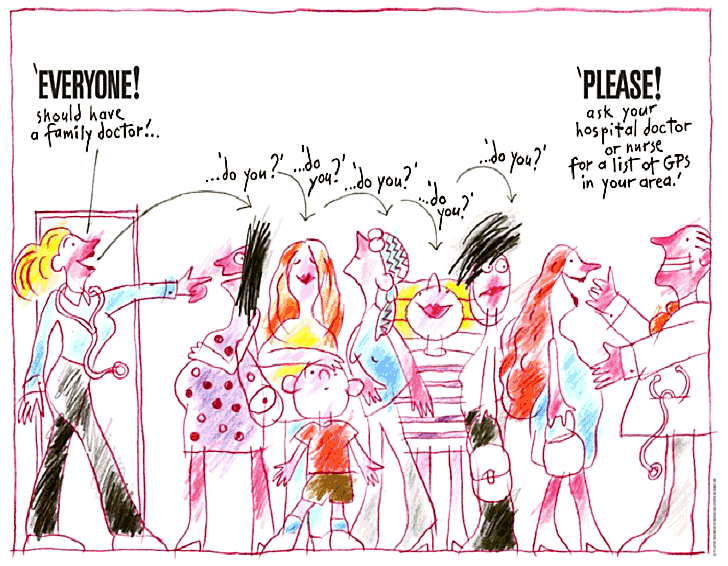
RWH 'Find a GP' strategy- 07th September 2004
The Royal Women's Hospital in Victoria have a strategy to encourage all hospital patients who do not currently have a personal GP to find one. The strategy includes a 'Find a GP' poster, which can be viewed on the internet site /_assets/http/www.rwh.org.au/emplibrary/gpaccess/familly_doc.gif.
HIC Internet statistics update - 06th September 2004
The Health Insurance Commission 'General Practice Statistics Reports' Web pages on the Internet have been updated with the latest quarterly data For Medicare and the Pharmaceutical Benefits Scheme (PBS). There is now data for Quarter 2, 2004 for Medicare and Quarter 1, 2004 for PBS. These reports can be accessed via the HIC Statistical Information page: http://www.hic.gov.au/statistics/imd/forms/gpStatistics.shtml
Website: http://www.hic.gov.au/statistics/imd/forms/gpStatistics.shtml
Preliminary guidelines for the implementation of community-based rehabilitation (CBR) approached in rural, remote and indigenous communities in Australia
A new article has been published in Rural and Remote Health: 'Preliminary guidelines for the implementation of Community Based Rehabilitation (CBR): approaches in rural, remote and Indigenous communities in Australia ' How do internationally promoted models of care, not necessarily designed by or for rural, remote or indigenous communities, translate to our specific contexts?' A recent conference tried to address this issue in relation to community based rehabilitation.
Website: http://rrh.deakin.edu.au/articles/showarticlenew.asp?ArticleID=291
New Cardiac Rehabilitation Framework launched
The National Heart Foundation of Australia and the Australian Cardiac Rehabilitation Association have released the new Recommended Framework for Cardiac Rehabilitation 2004 - to guide the establishment, content and ongoing development of cardiac rehabilitation services.
Key features:
- Recognition of the under-representation of Aboriginal and Torres Strait Islander people in cardiac rehabilitation programs. In addition the need for Aboriginal Health Workers to be supported as key members of a cardiac rehabilitation team delivering to Aboriginal and Torres Strait Islander communities.
- The importance of discharge planning as a crucial source of referral to cardiac rehabilitation services and a means of delivering continuity of care.
- Effective self-management by patients as a key objective of outpatient cardiac rehabilitation programs.
- Advocating for programs to utilise the new Australian Institute of Health and Welfare Data Set Specification when collecting any cardiovascular data.
- An emphasis on the need for a diversity of settings for, and models of delivery of, cardiac rehabilitation services.
- Recognition of the important role of General Practice.
For a copy of the Framework please call Heartline on 1300 36 27 87 (local call cost) or go to www.heartfoundation.com.au and follow the Health Professional>Rehabilitation links.
Children's Epilepsy Program - resources for clinicians
The Children's Epilepsy Program is a coordinated clinical service providing access to the best care for children with epilepsy and related disorders. It is based out of the Royal Children's Hospital in Melbourne, in conjunction with Austin Health and the Monash Medical Centre. The program aims to raise awareness about epilepsy in children and adolescents, and provide patients, carers and healthcare professionals with the most up-to-date information about epilepsy and its treatment. The Program's website (http://www.rch.org.au/cep) includes useful resources for parents and professionals.
Information of particular value to paediatricians during consultations have also been published on the Hospital's General Medicine website, and can be accessed directly at www.rch.org.au/genmed/clinical.cfm?doc_id=7029. Topics published here include:
- Drugs - Choice, Details and Prescribing, Drug Dosing Schedule
- Seizure Diary, Management Plan
- Rectal Diazepam - Brochure and Video
- Epilepsy and driving.
Prevention in General Practice - RACGP resource update
The RACGP produces a number of resources to aid the implementation of prevention in General Practice, including:
-
The Red Book - Guidelines for preventive activities in general practice, 5th Edition 2002
-
The Green Book - Putting Prevention into Practice - Guidelines for the implementation of prevention in the general practice setting 1998
They are publicly available on the RACGP website, www.racgp.org.au
Both resources are currently being revised. One of the key strategies proposed for improving the implementation of prevention in General Practice are Practice Nurses and the RACGP would like to ensure that these resources include the voice of Practice Nurses and other Practice staff. Given that this could impact on you as a Practice Nurse the RACGP is keen to know your views. For more information download the attached file.
Would you be willing to talk about aspects of your work as a Practice Nurse?
Please contact: Christine Hansen (Green Book Project Officer)
Phone: 08 8267 8352
Email: christine.hansen@racgp.org.au.
NICS launches new Pressure Ulcer Resource Guide A new pressure ulcer resource guide, developed by the National Institute of Clinical Studies (NICS), has just been launched at the 5th National Australian Wound Management Association Conference. For more information, download the attached media release or visit the NICS website.
ANF Position Statement on Nursing in General Practice The Australian Nursing Federation has released a Statement on Nursing in General Practice. To download the statement, Click Here
Attention practice nurses You're invited to take part in the CHAT study, which is...the Chronic Heart-failure Assistance by Telephone Study. The aim of the study is to improve the management and support for your rural/remote CHF patients, as well as to develop a register of CHF patients for your practice, to learn about CHF and its management in general practice, to inform Clinical Audit: QA&CPD/ACCRM points, and also to assist with preparation of Care Plans for patients enrolled in CHAT (coordinated by research team)
To read more about this project, you can download more comprehensive information. For the Expression of Interest Flyer click here, and for info provided by Monash University, simply click here.
Nursing in General Practice Project The Royal College of Nurses, Australia (RCNA) and the Royal Australian College of General Practitioners (RACGP) are currently undertaking a joint project for the National Steering Committee for Nurses in General Practice, funded by the Commonwealth Department of Health and Ageing.
To read more about this project, you can download the blurb by clicking here.
Mentoring Program for Nurses in General Practice
For more information on Mentoring, we have a document for you to download here.
For the document called Developing A Mentoring Framework for General Practice Nurses, simply click here.
State legislation/regulation affecting immunisation by practice nurses in general practice The Australian Government fact sheet about the new MBS item 10993, which remunerates practices for immunisation services provided by practice nurses, states that "the practice nurse must... be appropriately qualified and trained, including compliance with any state or territory requirements, to provide the relevant services for the particular [MBS] item".
The aim of this fact sheet is to advise on the relevant Victorian requirements.
Advice to Victorian Divisions of General Practice
According to The Drugs, Poisons and Controlled Substances Act 1981 and Regulations 1995, a Division 1 registered nurse is able to provide immunisation services in the general practice setting when:
a. The Division 1 registered nurse is an accredited nurse immuniser. This nurse is able to both possess and administer the vaccine independently of the medical practitioner. The medical practitioner should be available to provide advice to the nurse on the use of the vaccine.
b. The nurse is a Division 1 registered nurse who is not an accredited nurse immuniser. This nurse must obtain verbal or written authorisation from the medical practitioner to access and administer the vaccine for each patient. There should be a written record of this authorisation, and that the patient has consented, for each patient vaccinated by the nurse. In case of an anaphylactic reaction the medical practitioner should be physically available.
Note that:
'Off-site' immunisation can only be performed by an accredited nurse immuniser or by a Division 1 registered nurse (non-accredited nurse immuniser) who has the medical practitioner available on-site to sight the patient.
Nurses are at all times accountable and responsible for their actions, and to be aware of the limits of their knowledge and competence, and to work within these limits.
It is expected that nurses providing immunisation services will have read the documents below; have a demonstrated knowledge of them; and be able to refer to them.
-
-
-
'General statement for nurses undertaking clinical practice/procedures' from the Nurses Board of Victoria, at www.nbv.org.au under 'Publications'.
|



 > What's new